Sued by a debt collector in Indiana? The clock is already running.

Once you're served you have about 20 days to file a written Answer. Say nothing, and the collector wins by default — Indiana lets them take up to a quarter of your paycheck. We prepare your court-ready Answer for a flat $149.

Sued in Missouri instead? Go to the Missouri page.

  • Not a law firm — we say so plainly
  • Verify every fact on the state's own site
  • Flat fee, no hourly billing
Start here
Tx Civil Help Inc, a Texas corporation Payments through Stripe Non-attorney document preparation How to check we're real
A woman at her kitchen table reading a letter she has just opened, calm
Lawsuits are public the day they're filed. Serving the papers takes days or weeks — that gap is your head start.

Check the record

Is this real?

Don't take our word for it. Every Indiana lawsuit is public record. Type the cause number from our message or your papers: we decode it, and if it's a case we've read from the public docket, we show you exactly what the court published, so you can check it against the state's own site.

Decode your cause number

Type it exactly as it appears on our message or your papers.

County
Court
Filed
Case type
A man at his kitchen table at night, hands clasped, looking at a calendar
Most people find out how long they had after it's gone. Indiana Trial Rule 6(D)(1): twenty days. Rule 6(G): three more if the papers came by mail.

Your deadline

How long do you actually have?

Most people guess. Guessing is how deadlines get missed. Enter the day the papers reached you.

pick a date

Your deadline appears here, with the exact day of the week.

An estimate from the Trial Rules, not legal advice; it does not account for court holidays or an extension a judge granted. Always confirm your own date with the court — we'll help you check, free.

The cost of doing nothing

What silence costs.

Indiana courts recorded 153,306 civil collection lawsuits in 2025 — about 420 a day.1 Debt buyers file in bulk because most people never answer. A judgment doesn't stay the size it started at, and it can be collected straight out of your wages.

Doing nothing vs. answering

Judgment against you
After three years of statutory interest
Filing an Answer with us$149

A woman on the limestone steps of a courthouse holding a folder of documents, calm and confident
Indiana's courts are built for people who represent themselves. The rules that protect you are written down, and they don't change because you don't have a lawyer.

Your rights

What the law gives you.

A lawsuit is a claim, not a verdict. Before a judge signs anything, the company suing you has a list to get through. Yours is shorter.

The collector's job

  • Prove the account is yours
  • Prove it owns the account: every sale from the original bank down to the company suing you
  • Prove the amount, charge by charge, fee by fee
  • Prove it sued within six years of your last payment
  • Prove you were properly served

A debt buyer that paid about four cents on the dollar has to do all of this before a judgment can be entered against you.

Your job

  • File a written Answer within 20 days of being served
  • Show up when the court sets a date

We prepare the first one. You sign it on your phone and file it, free.

Nothing is decided yet.A lawsuit is a claim, not a verdict. No one can take money from your wages or your bank account until there is a judgment and a further court order after it.Ind. Trial Rule 69(E)
A plain denial is enough to start.Indiana lets you deny the claims in ordinary words. If you don't know whether something is true, saying so counts as a denial.Trial Rule 8(B)
Silence is treated as agreement.Whatever you don't deny, the court takes as admitted. That is the whole reason an Answer matters.Trial Rule 8(D)
They carry the proof, not you.You are not required to prove you don't owe it. The plaintiff must prove that you do, with records, and the Answer demands them.Trial Rules 8(B), 8(C)
Old debt has a time limit.Most consumer debt cannot be sued on more than six years after the last payment or default. A lawsuit filed after that can be defended on that ground alone.IC 34-11-2-7, 34-11-2-9
Your paycheck has a floor.Even after a judgment, garnishment is capped at a quarter of take-home pay, never touches the first $217.50 a week, and a judge can lower it to a tenth for good cause.IC 24-4.5-5-105
Some money and property can't be touched.Social Security, SSI, veterans' and disability benefits are protected by federal law wherever they're deposited, and Indiana exempts part of a home's equity and other property from collection on a judgment.42 U.S.C. §407 · 38 U.S.C. §5301 · IC 34-55-10-2
Collectors have rules too.Federal law bars false statements, threats, and calls before 8 am or after 9 pm, and gives you 30 days from a collector's first notice to demand proof in writing.15 U.S.C. §1692c, e, g
Bad service is a defense.If the papers never properly reached you, you can say so, and the case can be dismissed on that alone.Trial Rules 8(C), 12(B)(5)
They paid pennies for this.The Federal Trade Commission's study of the industry found debt buyers paid about 4 cents per dollar of face value, and that sellers limited what account documents buyers could get afterwards.FTC, 2013
This is information about how Indiana's rules work, in plain English. It is not advice about what you should do in your case. We prepare the documents you choose to file, and we'll tell you when we think a lawyer should look at yours.


The package

What we prepare, and how it works.

Text us your cause numberWe confirm the case in the public record and text you back, usually the same day.
We read your court recordCourt, cause number, plaintiff, service, deadline. Then we ask you the few questions only you can answer.
You review and sign on your phoneEverything is prepared for your case. Sign it with your finger. No printer needed.
You file it, freeE-file through the state's own system, or hand it to the clerk. We stay on text and email until it's in.
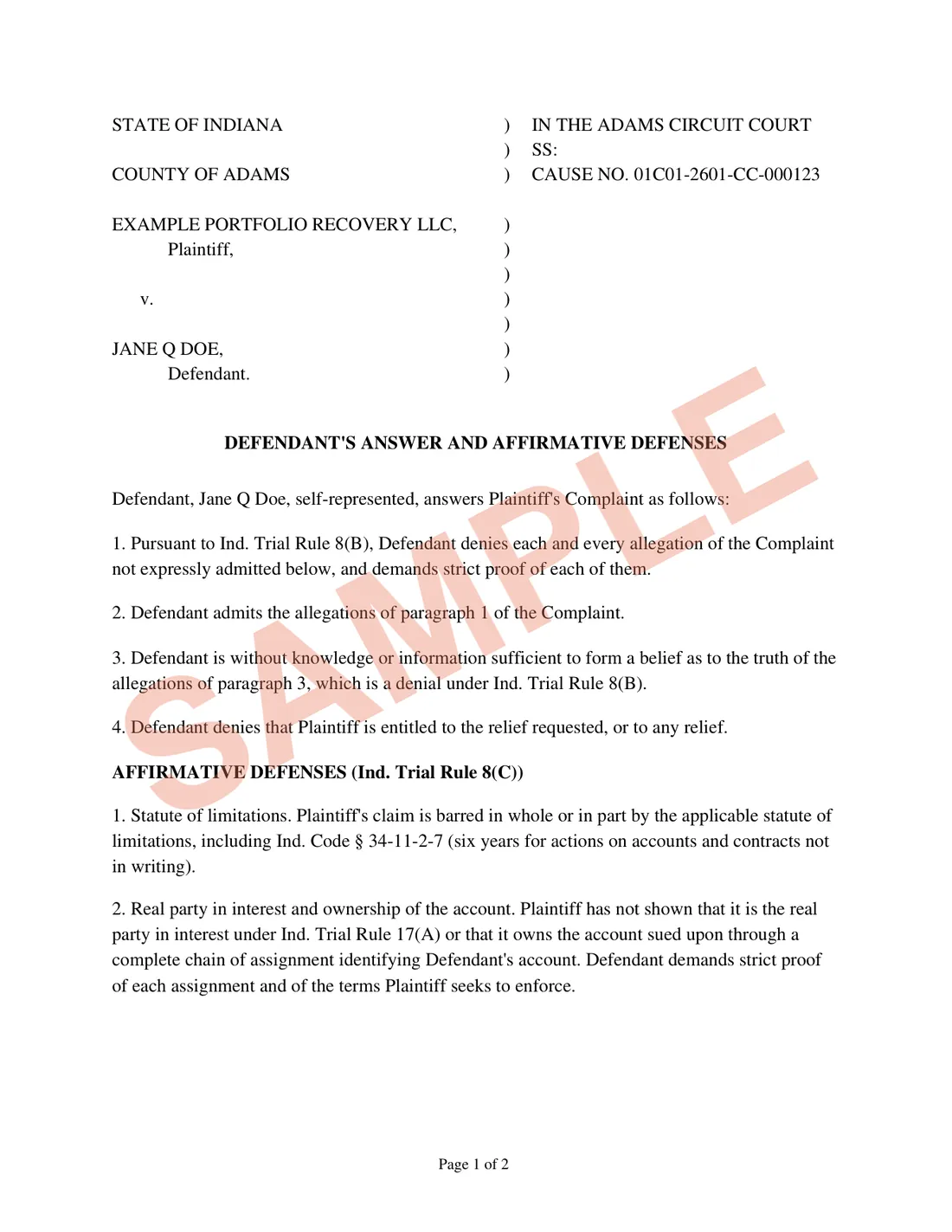
Page one of a sample Answer prepared by MyCivilHelp for a fictitious defendant, watermarked SAMPLE
Page one of a real Answer from our builder, for a fictitious defendant. Yours carries your court, your cause number, and the choices you make.
$149flat, for the whole package
  • Appearance formThe state's own form every self-represented party must file, filled in for your court and cause number.
  • Written Answer, with certificate of serviceResponds to each claim in the complaint and requires the collector to prove it owns your debt and that the amount is right.
  • Notice for 30 more daysIndiana lets you take one automatic extension by filing a notice in time. It's in the package, ready, if you need it.
  • Filing instructionsE-file or hand it in, step by step. Filing an Answer costs you nothing at the courthouse.
  • What happens nextWhat the collector may do in the following weeks, and what each notice means.
  • Questions answered by text and emailUntil it's filed, and after.
No printer? Sign it on your phone, free. Your file never leaves your device.

You review it, you sign it, you file it, you stay in control. We don't give legal advice or promise an outcome — we prepare the documents you choose to file, and we get the details right.

About us

Who we are — and who we aren't.

MyCivilHelp is the Indiana service of Tx Civil Help Inc, which has prepared debt-defense documents for people sued by debt buyers since 2025. We are not a law firm and we will never pretend to be one.

Founder & software developer

Uma Maheshwar Reddy Thipparthi

Uma founded Tx Civil Help in 2025 after seeing how routinely people lose debt cases by default: beaten by a missed deadline rather than by the facts. The company was built around a single idea: the paperwork that protects you shouldn't cost more than the debt you're being sued over.

He wrote the software that reads the public docket, counts the deadline and prepares each package, and he sets how we operate: flat, published pricing instead of hourly billing, plain English instead of legalese, and a written reply to every person who contacts us, whether or not they ever become a client.

Uma is not an attorney, and we do not give legal advice. We prepare court documents at your direction.

View founder profile on LinkedIn

We'd rather you pick the right option than the one that pays us. Here is every route, including the free ones.

Do nothingEverythingDefault judgment. Garnishment can follow. This is the outcome in most of these cases — it's what the collector's business model counts on.
Hire an attorney$1,000+The strongest option if your case is large or complicated — and we'll tell you when we think it is.
Online form generator$0–$67You answer a questionnaire and software fills a template. Reading the record and getting the details right are on you.
Do it yourselfFreeAbsolutely possible. Indiana has no official Answer form, so you draft the pleading. indianalegalhelp.org has resources; legal aid may help if you qualify.
MyCivilHelp$149We read your actual court record, prepare the complete package for your case, and answer your questions by text and email until it's filed.
How did you know I was sued?

Indiana court filings are public record from the day they're filed. We read the public civil collection docket — the same record you can search yourself at mycase.in.gov, which is exactly why we hand you the cause number and ask you to check.

What if I haven't been served yet?

Then you're in the best position of anyone reading this. Your 20 days don't start until you're served, so you can have the response ready and file it the moment the clock starts.

Is $149 really the whole price?

Yes. Filing an Answer as a defendant costs nothing at the courthouse, and Indiana's e-filing service is free for self-represented parties. No hourly billing, no charge for questions.

What if I actually owe the money?

Plenty of people do, and filing an Answer is still worth it. An Answer doesn't claim you owe nothing — it requires the plaintiff to prove its case: that it actually owns your debt, and that the amount is right. Debt buyers purchase accounts in bulk and the paperwork is often thin.

It also keeps you in the conversation. A defendant who shows up can discuss the case; a default judgment is simply entered against you.

I already have a judgment against me. Is it over?

Not necessarily. Indiana Trial Rule 60(B) lets a person ask the court to set a judgment aside in certain situations, for example when the papers never properly reached you, within time limits that depend on the reason (one year for most of them). Whether that applies to you depends on the record. Text us the cause number and we'll tell you what the docket shows and what the options are, at no charge.

Who is behind MyCivilHelp?

Tx Civil Help Inc, a Texas corporation founded in 2025 by Uma Maheshwar Reddy Thipparthi, who runs it today. You can reach us at [email protected] or by text at (888) 396-7107. Texas is where we started; Indiana is where we work next.

Before you trust us

Worried this is a scam? Good. Check.

A text about a lawsuit from a company you've never heard of should make you suspicious. Every item below is a record we don't control. Check them, then decide.

The company is on the public record

Tx Civil Help Inc is a Texas corporation, Secretary of State file no. 806499657, at 5900 Balcones Dr #13025, Austin, TX 78731. Search the name on the Texas Comptroller's own site.

Search the Texas Comptroller

A named owner you can look up

Uma Maheshwar Reddy Thipparthi founded the company in 2025 and runs it today. His professional profile is public, and the company he runs is the one that will be preparing your documents.

Uma on LinkedIn

Your case is on the state's site

We only know what the court published. Look your cause number up at the top of this page, then check the same number yourself on mycase.in.gov, run by the Indiana judiciary.

Open mycase.in.gov

Payment goes through Stripe

Card details never come to us. The receipt says Tx Civil Help Inc, the charge is $149, once, and there is no subscription. The Texas site takes payment the same way.

See the Texas site
What we will never ask forYour Social Security number, your bank login, or a card number by text or email. And we never ask you to pay before you've checked your case on the state's site.
How we reach youTexts come from (888) 396-7107 and email from [email protected]. We don't phone you; anything else isn't us. Text us before you decide anything. Verifying costs nothing.

Step-by-step instructions for the state's site, and a cause-number lookup, are on the verify page.

Text message updates

Get case updates by text

Give us your mobile number and we'll text you about your case — deadline reminders, answers to your questions, and confirmation when your documents are ready. This is opt-in: we only text people who ask us to.

SMS terms & consent

How you opt in. We send text messages only to people who have asked us to: by submitting the form on this page, by texting us first, or by giving us your mobile number when you contact us by email or through this site. We do not send text messages to people who have not opted in.

What we send. Case notifications, deadline reminders, replies to your questions, and confirmation when your documents are ready. Message frequency varies by your case. Message and data rates may apply.

How to stop. Reply STOP to any message and we stop immediately and permanently. Reply HELP for help, or email [email protected]. You can also opt out at any time by emailing us.

Your privacy. We never sell, rent, or share your mobile number with third parties, and we do not share it for marketing purposes. Carriers are not liable for delayed or undelivered messages. We honor the Indiana Do Not Call registry.

Questions: [email protected] · MyCivilHelp is a service of Tx Civil Help Inc, 5900 Balcones Dr #13025, Austin, TX 78731.

Check my deadline — free