Nothing is decided yet.A lawsuit is a claim, not a verdict. No one can take money from your wages or your bank account until there is a judgment and a further court order after it.Ind. Trial Rule 69(E)
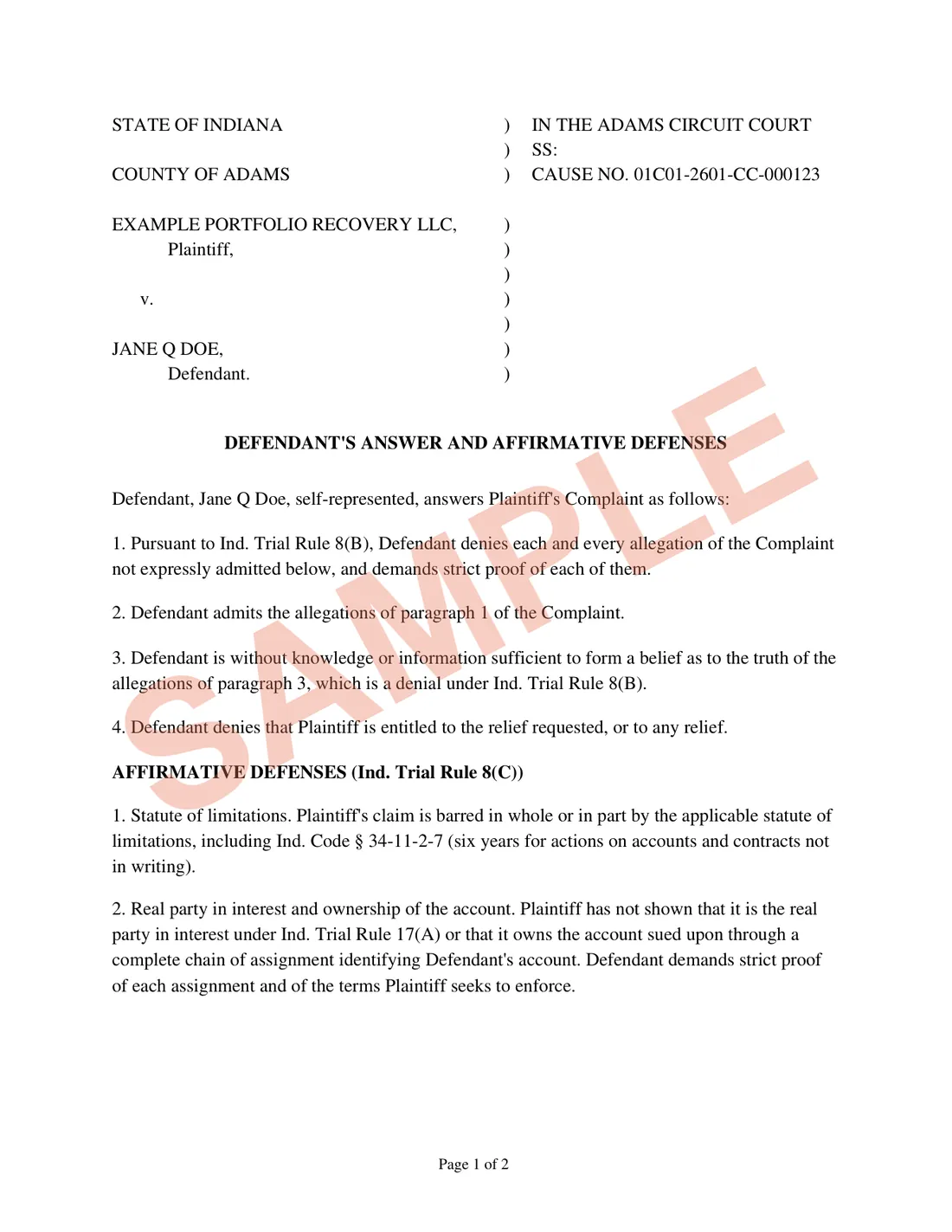
A plain denial is enough to start.Indiana lets you deny the claims in ordinary words. If you don't know whether something is true, saying so counts as a denial.Trial Rule 8(B)
Silence is treated as agreement.Whatever you don't deny, the court takes as admitted. That is the whole reason an Answer matters.Trial Rule 8(D)
They carry the proof, not you.You are not required to prove you don't owe it. The plaintiff must prove that you do, with records, and the Answer demands them.Trial Rules 8(B), 8(C)
Old debt has a time limit.Most consumer debt cannot be sued on more than six years after the last payment or default. A lawsuit filed after that can be defended on that ground alone.IC 34-11-2-7, 34-11-2-9
Your paycheck has a floor.Even after a judgment, garnishment is capped at a quarter of take-home pay, never touches the first $217.50 a week, and a judge can lower it to a tenth for good cause.IC 24-4.5-5-105
Some money and property can't be touched.Social Security, SSI, veterans' and disability benefits are protected by federal law wherever they're deposited, and Indiana exempts part of a home's equity and other property from collection on a judgment.42 U.S.C. §407 · 38 U.S.C. §5301 · IC 34-55-10-2
Collectors have rules too.Federal law bars false statements, threats, and calls before 8 am or after 9 pm, and gives you 30 days from a collector's first notice to demand proof in writing.15 U.S.C. §1692c, e, g
Bad service is a defense.If the papers never properly reached you, you can say so, and the case can be dismissed on that alone.Trial Rules 8(C), 12(B)(5)
They paid pennies for this.The Federal Trade Commission's study of the industry found debt buyers paid about 4 cents per dollar of face value, and that sellers limited what account documents buyers could get afterwards.FTC, 2013
This is information about how Indiana's rules work, in plain English. It is not advice about what you should do in your case. We prepare the documents you choose to file, and we'll tell you when we think a lawyer should look at yours.