A judgment needs proof.If you don't appear or answer as your summons says, the court may enter judgment on proof of the facts the plaintiff is entitled to.Wis. Stat. 799.22(2), (3)
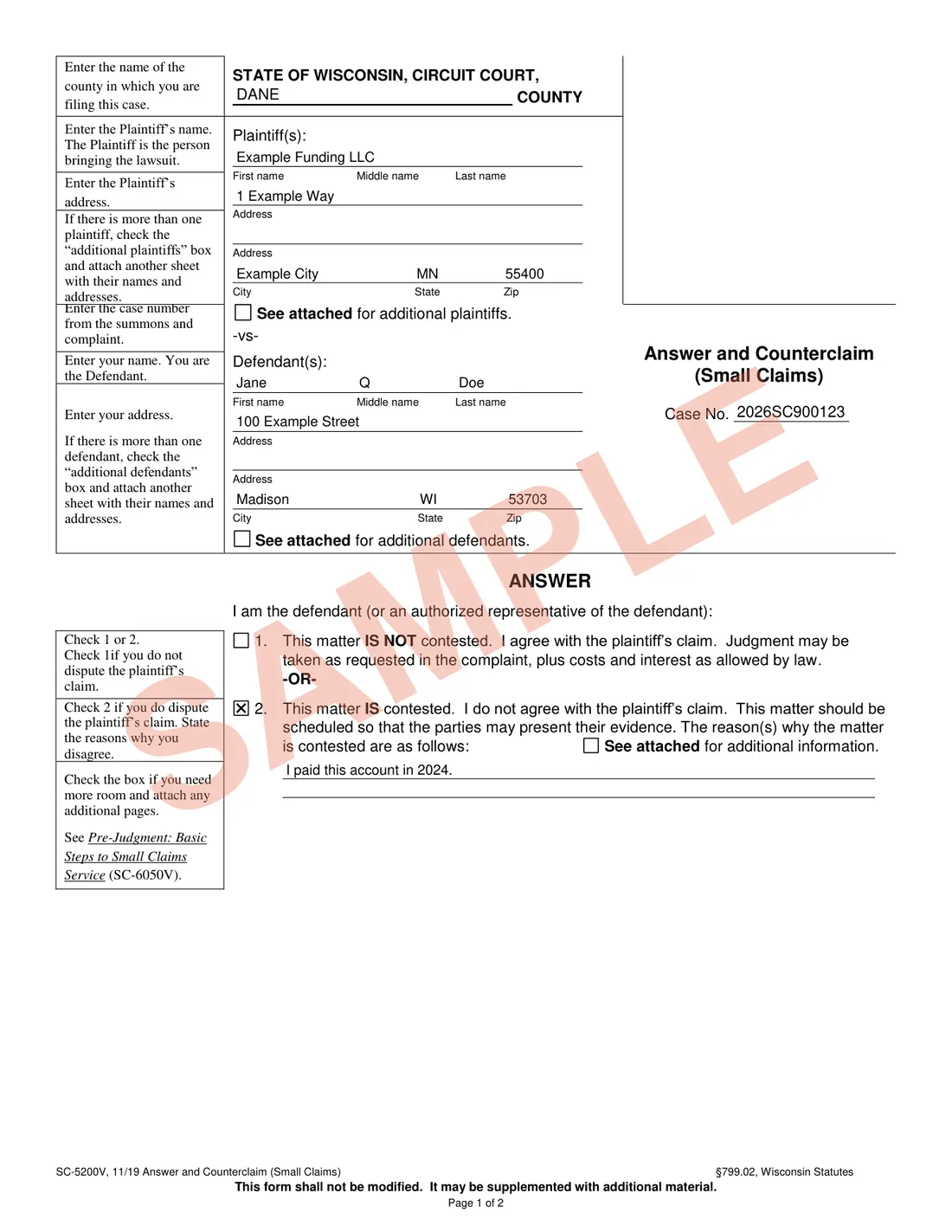
The court has its own answer form.You mark whether the claim is contested and give your reasons in your own words. No notary is needed.Form SC-5200V · Wis. Stat. 799.20
Documents on request.On a credit-card account, the plaintiff must provide copies of the writings showing your obligation if you ask in writing by the return date — and no default judgment may be entered until it does. A billing statement showing the total balance is enough.Wis. Stat. 425.109(1)(h), (2)
Where the case belongs.A consumer credit case belongs in the county where the customer resides or is personally served, where any collateral is, or where the credit was obtained or signed for.Wis. Stat. 421.401
Old debt has a time limit.An action on a contract must be started within 6 years after it accrues; after that, the right itself is extinguished.Wis. Stat. 893.43, 893.05
Most of your pay stays yours.Even after a judgment, 80% of disposable earnings is exempt from garnishment — and all of it when household income is below the poverty line or you receive need-based public assistance.Wis. Stat. 812.34(2)
Some money can't be touched.Social Security and veterans' benefits are protected by federal law, and Wisconsin exempts up to $5,000 in bank and credit-union accounts kept for personal use.42 U.S.C. §407 · 38 U.S.C. §5301 · Wis. Stat. 815.18(3)(k)
Debt collectors have rules too.Federal law bars debt collectors from false statements and threats, and from calls before 8 am or after 9 pm.15 U.S.C. §1692c, e
A default can be reopened.There is no appeal from a default judgment, but the court may reopen it on a motion showing good cause, made within 12 months after the judgment.Wis. Stat. 799.29(1)
If a debt buyer is suing.The Federal Trade Commission's study of the industry found debt buyers paid about 4 cents per dollar of face value. (Many Wisconsin suits are brought by the original bank or lender instead.)FTC, 2013
This is information about how Wisconsin's rules work, in plain English. It is not advice about what you should do in your case. We complete the court's form with your information and your own words, and we'll tell you when we think a lawyer should look at yours.